It was in the early 1990s that legendary playwright Thoppil Bhasi directed the stage play Olivile Ormakal (Memories in Hiding), the theatrical adaptation of his autobiography of the same name, under the banner of Kerala People’s Arts Club (KPAC), the powerful drama troupe associated with the Communist movement in Kerala. Much to the elation of theatre lovers, the KPAC will stage a remake of the play to mark its 75th anniversary and the birth centenary year of Bhasi.
According to A. Shahjahan, secretary, KPAC, Olivile Ormakal will be staged after a gap of several years with slight modifications “to keep up with changing times.”
Last play
“Thoppil Bhasi’s association with KPAC began with the historical play Ningalenne Communistakki (You Made Me a Communist) in the early 1950s. Olivile Ormakal was his last play (1992) under the banner of the KPAC. We decided to remake it as a fitting tribute to him on the occasion of his birth centenary,” says Shahjahan.
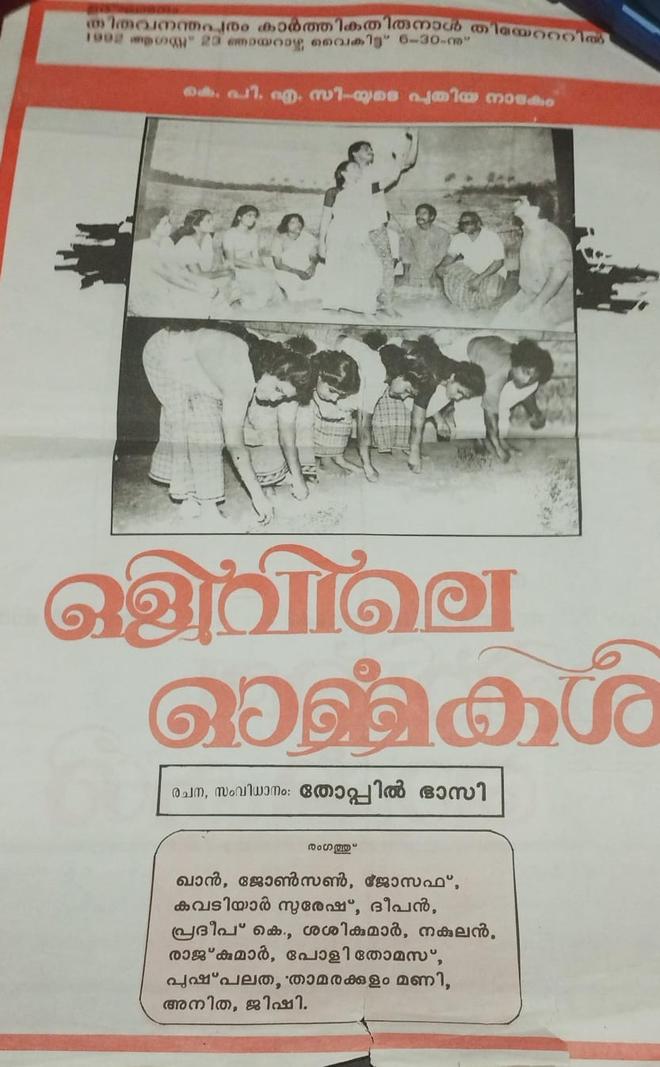
Olivile Ormakal was first staged at Karthika Thirunal Theatre, Thiruvananthapuram, on August 23, 1992, less than four months before Bhasi died.
Manoj Narayanan will direct the remake of the play and the rehearsal has begun. With some changes in the style of narration, the play is expected to gift a new experience to the audience.
Besides new actors, two members of the original cast, Pradeep Thoppil and Thamarakulam Mani, will appear in the remake of the play.
Historical significance
Mr. Narayanan says the play has historical significance beyond being the theatrical adaptation of Bhasi’s autobiography. “The intention of the play, when it was first adapted, was not to focus on the life of the individual but to narrate the story of that time. This approach made it more significant and interesting,” he says.
The play’s narrative is structured in such a way that Bhasi, despite the base text being his autobiography, does not prominently come to the stage as a character. “His presence is felt throughout the narrative but it focuses more on conveying the socio-cultural realities of the time,” says Mr. Narayanan.
It is widely assumed that the KPAC came into being in 1950. According to the KPAC website, towards the end of 1950, N. Rajagopalan Nair, G. Janardhana Kurup and others decided to stage Dostoevsky’s The Brothers Karamazov in Malayalam. A public notice was printed in the name of Kerala People’s Arts Club but nothing came out of it. Ente Makananu Sari (My Son is Right), the first major play by the KPAC, was staged in 1951.
Clarion call
Around the same time, Bhasi, who was in hiding after being hunted by the police in connection with a violent communist uprising at Sooranad in Kollam, wrote the script for Ningalenne Communistakki while on the run under the pseudonym Soman. The drama, “a protest against the feudal system that prevailed in Kerala” made the clarion call to “rise and fight oppression” and was first staged by the KPAC at Chavara in Kollam, in December 1952. Thus began the long term association between the KPAC and Bhasi.
The KPAC has so far staged 66 plays in the past seven decades including 16 written/ directed by Bhasi. To mark the 75th anniversary, it will open a “Theatre Museum”, touted as a first-of-its-kind initiative in India, to tell the history of stage plays in the country at Kayamkulam.